

 Facebook
 X
X
 Pinterest
 Copy Link
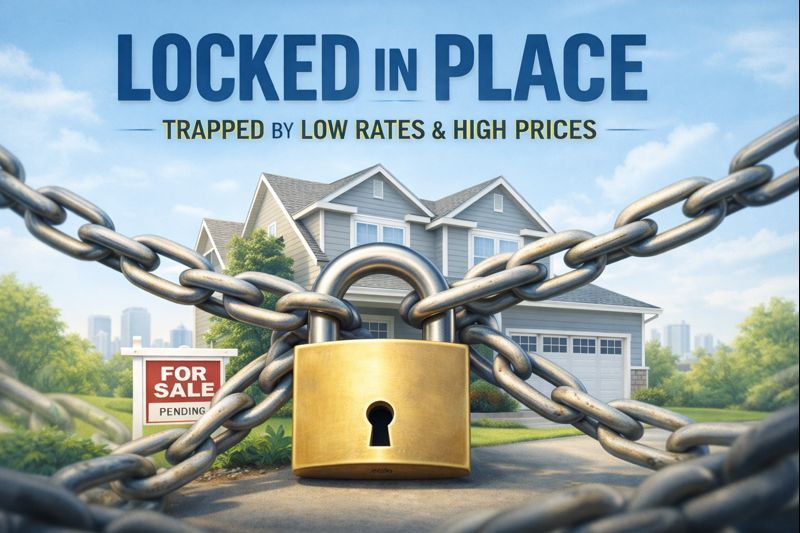
For years, America’s housing challenges have been framed as a simple supply-and-demand problem—low inventory, rising interest rates, and affordability constraints. But beneath those familiar headlines lies a deeper, structural issue we unintentionally created.
Today, millions of homeowners are wealthier on paper than ever before. They hold record levels of equity and historically low mortgage rates. Yet many of them cannot afford to move.
Not because they lack buying power.
But because moving no longer makes financial sense.
The Mortgage Lock-In Effect
Recent national data shows just how severe this gap has become. According to Realtor.com, the typical U.S. homeowner currently pays about $1,300 per month in principal and interest. Selling that home and purchasing a “typical” home today would require a monthly payment of approximately $2,236—a 73% increase in housing cost.
This growing gap is known as the mortgage lock-in effect. Homeowners who secured ultra-low rates during 2020–2021 are effectively trapped by them. Giving up a 3% mortgage to buy into today’s higher-rate, higher-price market often means paying significantly more—sometimes for a comparable or even smaller home.
The market isn’t frozen because people don’t want to move.
It’s frozen because moving comes with a financial penalty.
From Pandemic Stimulus to Market Stagnation
When mortgage rates fell below 3% during the pandemic, buyers surged into the market. Millions refinanced. Millions more purchased homes. Cheap financing softened the sting of rising prices, allowing values to climb rapidly—often 25% to 40% in many markets.
When inflation followed, rates snapped back sharply. Prices, however, did not.
The same mechanism that once encouraged mobility now suppresses it.
Federal housing research confirms this effect. A Federal Housing Finance Agency (FHFA) working paper estimates that rising mortgage rates have prevented millions of otherwise normal home sales by discouraging owners from listing their homes.
Why Homeowners Are Staying Put
It’s easy to assume homeowners stay because they “love their homes.” Many do—but that only tells part of the story. The real constraint is financial.
Homeowners face a stark choice:
-
Give up an exceptionally low interest rate
-
Buy into a market with both higher prices and higher borrowing costs
Even selling at a profit often results in higher monthly expenses and reduced flexibility. Equity becomes difficult to use when accessing it raises your cost of living.
This isn’t a lifestyle decision.
It’s a structural trap.
The Ripple Effect on the Housing Market
When homeowners can’t move, inventory shrinks. When inventory shrinks, affordability worsens—especially for first-time buyers.
This dynamic is already visible. Sellers are increasingly choosing to pull listings rather than cut prices or trade into higher-rate mortgages. According to Investopedia, delistings surged 45% year over year, highlighting the reluctance of owners to transact under current conditions.
Low inventory, in this context, is not the cause—it’s the symptom.
How We Unlock a Trapped Housing Market
This is not a short-term cycle. It’s a structural flaw that requires structural solutions:
-
Portable and assumable mortgages that allow buyers to take over existing low-rate loans
-
Incentives for downsizing and life transitions, particularly for long-time homeowners
-
Housing built for real demand, including townhomes, ADUs, and smaller, more attainable options
-
Modern mortgage products designed for flexibility and mobility—not just long-term lock-in
-
Greater transparency around equity use, so homeowners understand the true cost of moving
The Bottom Line
We built a housing system that rewards people for staying put and penalizes them for moving. The result is equity without freedom, ownership without mobility, and a market that struggles to function.
Mobility is not a luxury. It is a cornerstone of economic health and household well-being.
If we want a housing market that truly works, we must stop celebrating locked-in equity and start creating real pathways forward.
The American Dream only works if people can move with it.
Sources:
